
Altitude
2,115 metres
Opening status
Open in summer, closed in winter
Distance
18.9 km via Luz / 17 km via Campan
Activities
Road cycling
Climbing the Col du Tourmalet by bike: a challenge for everyone
Not to be missed !
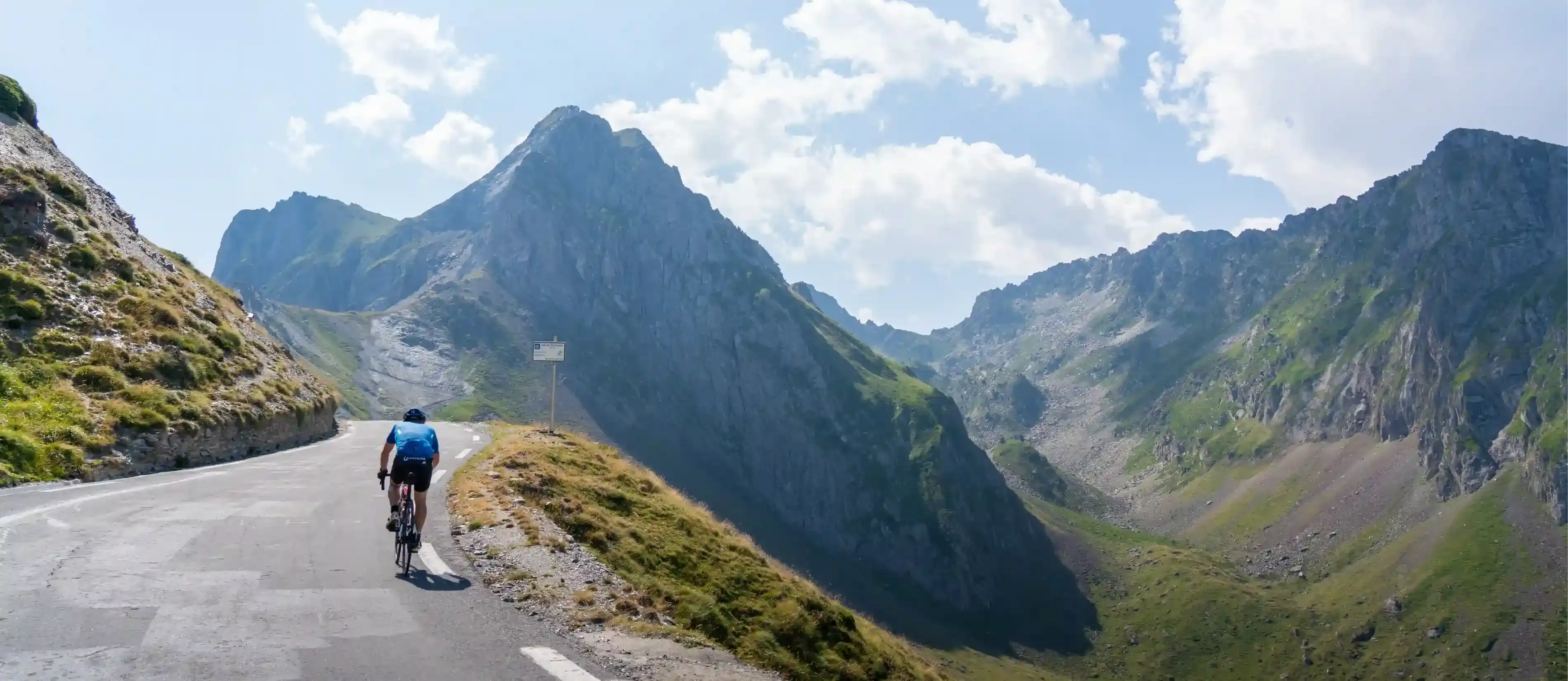
The Col du Tourmalet is a true monument of cycling and an essential pass in the French Pyrenees.
Whether you’re an amateur or an experienced cyclist, the ascent is a real challenge, rewarded with stunning landscapes and breathtaking views at the summit.
With its sustained gradients, demanding final kilometres, and legendary Tour de France history, climbing the Tourmalet is an unforgettable experience for any cycling enthusiast.
Discover the routes, climb profiles, and our best tips to conquer the Col du Tourmalet on two wheels 👇

Why is the Col du Tourmalet an iconic Tour de France climb ?
A must-see stage of the Tour de France
Since 1910, when it was first climbed by Tour de France riders, the Col du Tourmalet has become a true symbol of world cycling. With more than 80 appearances in the history of the Grande Boucle, it is the most frequently used Pyrenean pass in the race.
Every year, amateurs and professionals alike come to take on the ascent, following in the footsteps of cycling legends such as Eddy Merckx, Raymond Poulidor, Eugène Christophe, and Thibaut Pinot.
At the summit, a statue dedicated to Octave Lapize—the first rider to cross the pass in competition—stands as a reminder of its rich history.
Two sides, three routes, one goal
Reaching the summit of the Tourmalet by bike
This is the moment you’ve been waiting for (and perhaps dreading) for months. Ahead of you, the switchbacks rise towards the sky, winding between the giants of Barèges and La Mongie.
Whether you’re a seasoned climber chasing a personal best or a recreational rider taking on your first iconic pass on an e-bike, setting your wheels here means stepping into cycling history.
Here’s all the essential information about climbing the Col du Tourmalet by bike 👇
From Campan to the Col du Tourmalet (profile & GPX)
The climb of the giant
The ascent of the Col du Tourmalet from the eastern side is much more than a simple climb: it’s a pilgrimage.
Distance
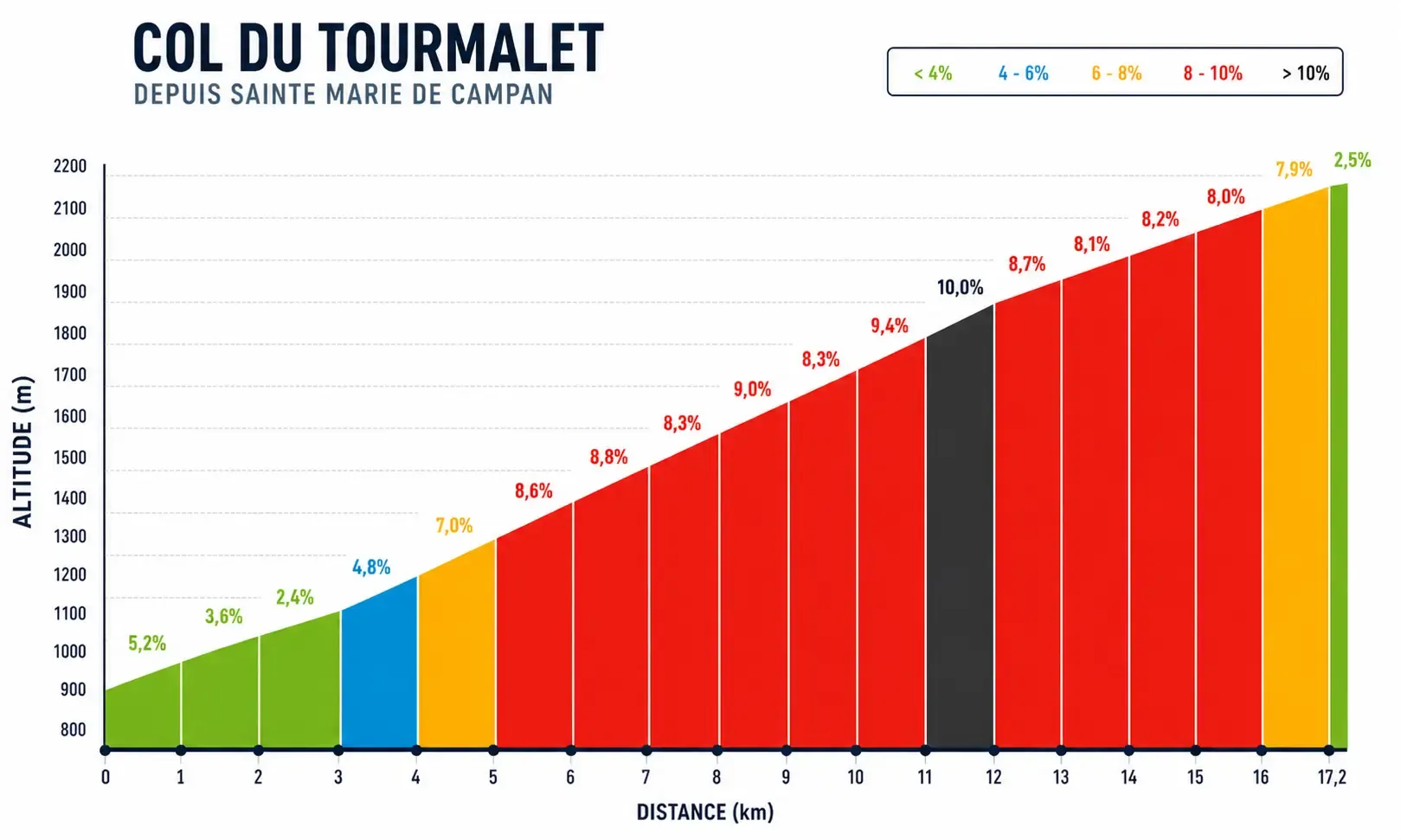
17 kilometres
Elevation gain
1,260 metres
Average gradient
7.4%
Steepest section
10.9%
The ascent of the Tourmalet from Sainte-Marie-de-Campan is a 17.2 km epic, clearly split into two distinct sections.
Unlike more regular climbs, this one demands perfect pacing to avoid blowing up before the summit.
- Warm-up (km 1 to 4): The climb starts gently. You leave Campan on gradients ranging from 1% to 6%. This is the time to find your rhythm and stay well hydrated. Enjoy it—what comes next is on a different level.
Start at Sainte-Marie Church
With its beautiful porch featuring seven arches in Payolle marble
Small waterfall
Around km 7, a refreshing spot to pause and cool off
Public toilets
At km 13 (just after leaving La Mongie)
Final bends
At km 15, the first—and last—proper switchbacks of the climb
Arrival at the Col du Tourmalet
You’ve made it—well done! Take some time at the top to enjoy the view

Apartments & Gîtes
•
Grand Tourmalet
•
2-15 pers.
From
€50/night
Hotels & Resorts
•
Grand Tourmalet
•
2-15 pers.
From
€99/night
Campsites
•
Grand Tourmalet
•
2-15 pers.
From
€55/night
Guesthouses
•
Grand Tourmalet
•
2-15 pers.
From
€55/night
From Luz to the Col du Tourmalet (profile & GPX)
The climb of the giant
Climbing the Col du Tourmalet from the west side by bike means taking on an 18.3 km monster of relentless consistency…
Distance
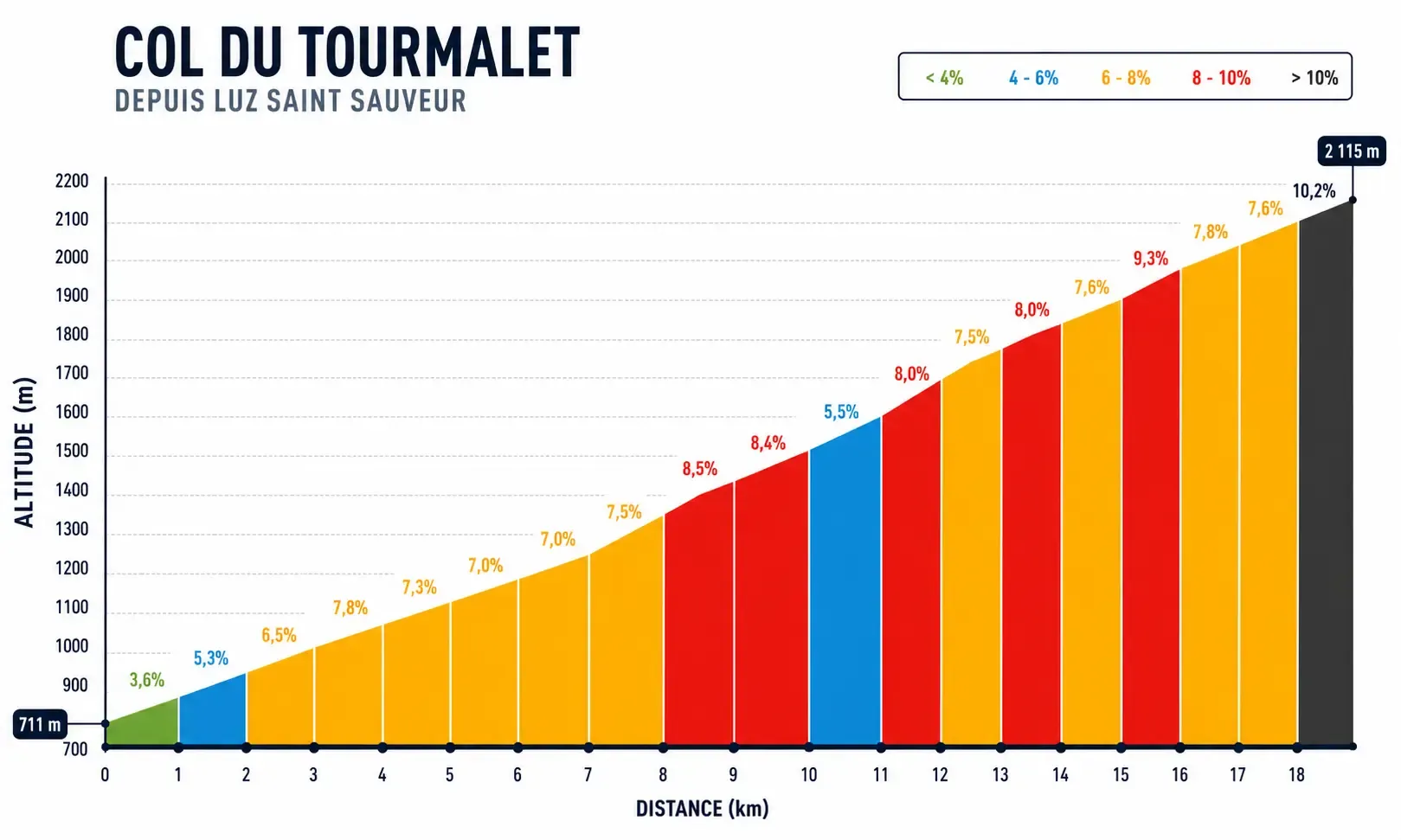
18.9 kilometres
Elevation gain
1,400 metres
Average gradient
7.7%
Steepest section
10.2%
The ascent from Luz-Saint-Sauveur is often favoured by cyclists who like to “settle into a rhythm”. At 18.9 km with an average gradient of 7.7%, this side of the climb offers almost no flat sections to recover.
It’s an honest climb: it shows its colours from the very start.
- Warm-up (km 1 to 7): Right from the outskirts of Luz, you’re straight into the climb, with gradients between 7% and 8%. The road rises above the river, offering a few welcome patches of shade if you’re riding in the height of summer…
Start in the centre of Luz-Saint-Sauveur
A roadside marker marks the official start of the climb.
Barèges village
At km 7, you pass through Barèges.
Public toilets & drinking water
At km 10.5 (at the Tournaboup car park).
Final bends
At km 17, the final switchbacks begin.
Arrival at the Col du Tourmalet
You’ve made it—congratulations! Take a moment at the top to enjoy the view.
Apartments & Gîtes
•
Grand Tourmalet
•
2-15 pers.
From
€50/nightHotels & Resorts
•
Grand Tourmalet
•
2-15 pers.
From
€99/nightCampsites
•
Grand Tourmalet
•
2-15 pers.
From
€55/nightGuesthouses
•
Grand Tourmalet
•
2-15 pers.
From
€55/night
All our tips for climbing the Col du Tourmalet
Before, during and after your ride
Climbing the Col du Tourmalet isn’t something you do on a whim. Between altitude, unpredictable Pyrenean weather, and the brutal final gradients, every detail counts.
Whether you’re setting off from Campan or Luz, here’s everything you need to turn the challenge into an unforgettable ride.
Getting ready for the climb
Get your ride ready
The Tourmalet doesn’t forgive poor preparation.
Here are 3 essential things to check before setting off:
1) Bike setup for high-mountain riding
Unless you’ve got pro-level legs, don’t overestimate your abilities.
- Gear ratio: a 34-tooth chainring paired with a 30 or 32 cassette is the standard setup to keep a smooth cadence even on 10% gradients.
- Brakes: check your pads or discs. The descent is long… and fast.
- Tyre pressure: slightly lower pressure (if you’re running tubeless) improves comfort on rough sections of tarmac.
.webp?v=3)

You're doing it !
Find your rhythm and keep turning the pedals.
Once you're clipped in, the Tourmalet becomes a battle of patience and pacing. Here are a few tips to help you reach the summit in good shape :
- The classic mistake is starting too hard on the gentler lower slopes. Keep your effort under control during the first half hour.
- Forget about average speed and focus on maintaining a smooth cadence (around 70–80 rpm).
- Change position regularly and keep your upper body relaxed.
- Break the climb into smaller targets: "Just to the next hairpin", "Just to the avalanche gallery"…
You did it !
Congratulations !
Le panneau "Col du Tourmalet 2 115 m" est derrière vous. Bravo ! Mais attention, l'aventure ne s'arrête pas au sommet;
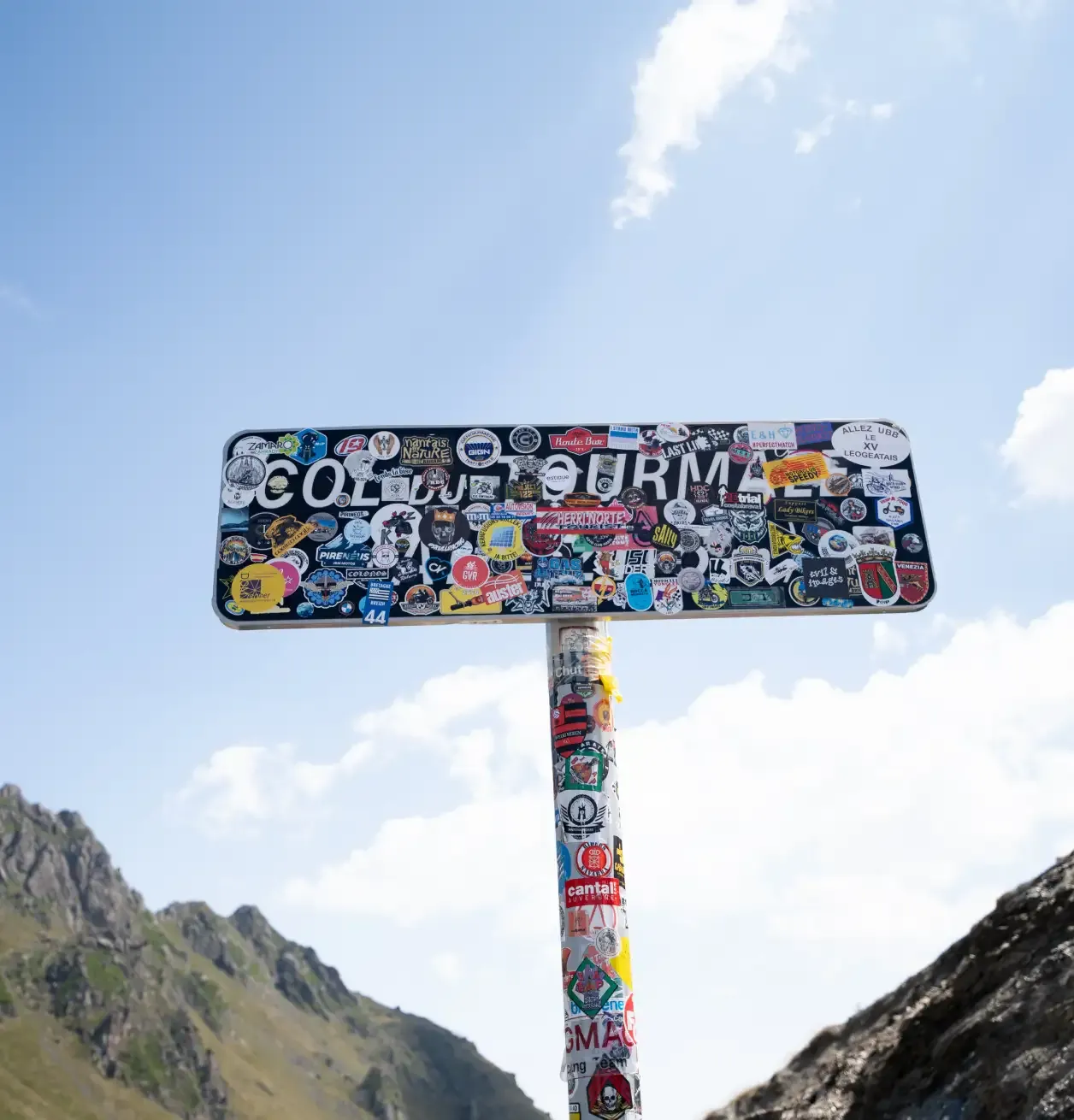
The famous Col du Tourmalet – 2,115 m sign is behind you. Take a moment to enjoy it - you've earned it.
Le rituel du sommet :
- La photo souvenir : c’est le moment de poser sous la statue d’Octave ou devant le panneau mythique. Ne vous pressez pas, savourez l'instant.
- Se couvrir immédiatement : c'est l'erreur de débutant la plus fréquente. Même s'il fait beau, la température chute et le vent est vif. Enfilez votre coupe-vent ou votre veste thermique avant même que votre rythme cardiaque ne redescende. La sueur froide est le meilleur moyen de tomber malade ou de tétaniser en descente...
The summit ritual
- The summit photo: Time to pose beside the Octave statue or in front of the legendary summit sign.
- Layer up straight away: Even on sunny days, temperatures can drop quickly at the top and the wind can be surprisingly chilly. Pull on a windproof or thermal layer before your body cools down.
.webp?v=3)
Octave Bistro at the Summit
Take a break and soak up the view
Cold drinks, generous mountain fare and one of the finest terraces on the Tourmalet. A favourite stop for cyclists before or after the climb.
Col du Tourmalet Cycling FAQs
We’re here to help !
The easiest option is to rent a road bike or an e-bike in Luz-Saint-Sauveur or Bagnères-de-Bigorre.
In peak season, make sure to book in advance!
Yes, absolutely. The Col du Tourmalet road is free and open to everyone.
All roads in the Hautes-Pyrénées are toll-free: the mountains for everyone.
Made of steel, the Giant of the Tourmalet statue honours Octave Lapize, the first rider to conquer these slopes in 1910. Beyond the tribute, it has become a symbol of mountain cycling legend.
The ascent record is held by French rider Thibaut Pinot, in 51 minutes and 13 seconds, averaging 22.1 km/h.
He set this time during the 2019 Tour de France on July 19.
The record was set between Luz and the summit on a closed road.
It depends on your fitness level. Here are some general guidelines:
- Beginner: 2h30 – 3h (easy pace with breaks)
- Experienced cyclist: 1h30 – 2h (steady, intense climb)
- Professional: under 1 hour (only the strongest climbers stay under this)
What riders say
You came for the climb, you stayed for the view
“Magnificent! Climbing it one pedal stroke at a time is absolutely doable. The cycling group Les Roses du Québec did it with great pride.”
Manon
“We went up out of curiosity, as it’s a legendary climb. The race passes in three days and fans are already there. The road is pleasant, but watch out for the cows—they are not impressed by bikes or vehicles. You really realise the effort pro cyclists put in. We’d gladly come back in winter, as there’s a large ski area around the pass.”
Paul
“A legendary Pyrenean climb and Tour de France icon. Stunning scenery. For cyclists, it’s best to start early to avoid traffic and strong heat. After Barèges, the climb becomes fully exposed…”
Christian
“A great ride for cyclists. Quiet in June. A mythical Tour de France location…”
Isa
“I rode it in mid-July and honestly, it’s something every cyclist should do at least once in their life. The climb is very tough, averaging around 7%, with final ramps up to 13%. My advice: pace yourself carefully as there are very few recovery sections, and take the Laurent Fignon road—it’s absolutely stunning despite its difficulty. A truly great experience.”
Nino
“The “holy grail” for cyclists in the Pyrenees. Be careful, the final kilometre is very tough.”
Patrick
“A legendary mountain pass every cycling enthusiast should experience at least once. Stunning views and a lively atmosphere with cyclists and motorbikes all around.”
Jordi